Sacred Mushroom or God's Flesh? The Mystery of Aztec Teonanácatl
This article aims to share scientific research findings and does not advocate or recommend anyone to try using any psychoactive drugs. Some highly toxic species have appearances very similar to hallucinogenic mushrooms, so it is recommended not to attempt picking and consuming wild fungi without professional knowledge. At the time of writing this article, psilocybin and its metabolite psilocin are both Category II controlled substances in Taiwan.
When people hear about magic mushrooms, most intuitively think of their hallucinogenic effects on vision or hearing. With the recent revival of controlled substance research, researchers are able to re-examine the medical value of magic mushrooms. This article will review past literature and articles, looking at what magic mushrooms really are from their historical origins.
Magic mushrooms teonanácatl Origins
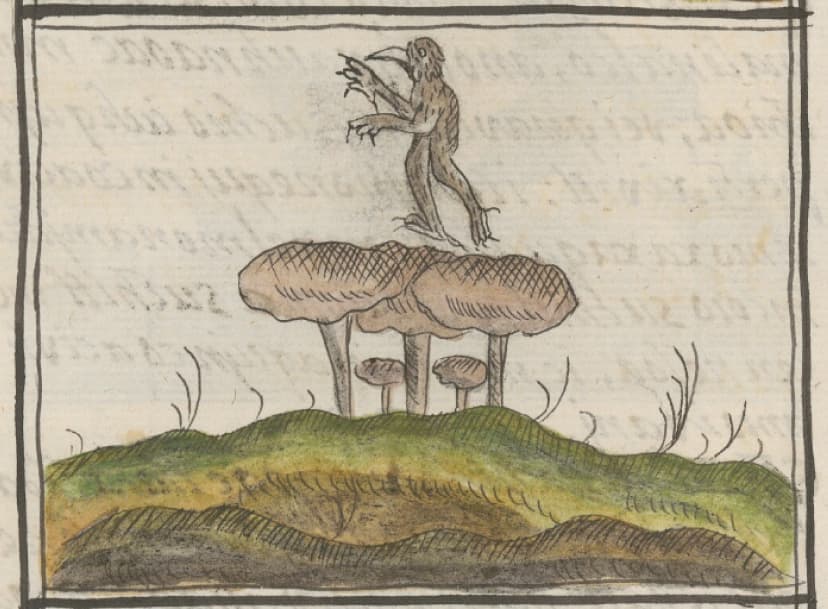
Image of Teonanácatl recorded in the Florentine Codex. Source: Digital Florentine Codex
Sixteenth-century Spanish missionary Bernardino de Sahagún, who came to the Aztec region with the fleet to evangelize, meticulously recorded Aztec culture and customs, compiling his observations into a volume called Histoire générale des choses de la Nouvelle-Espagne, also known as the Florentine Codex.
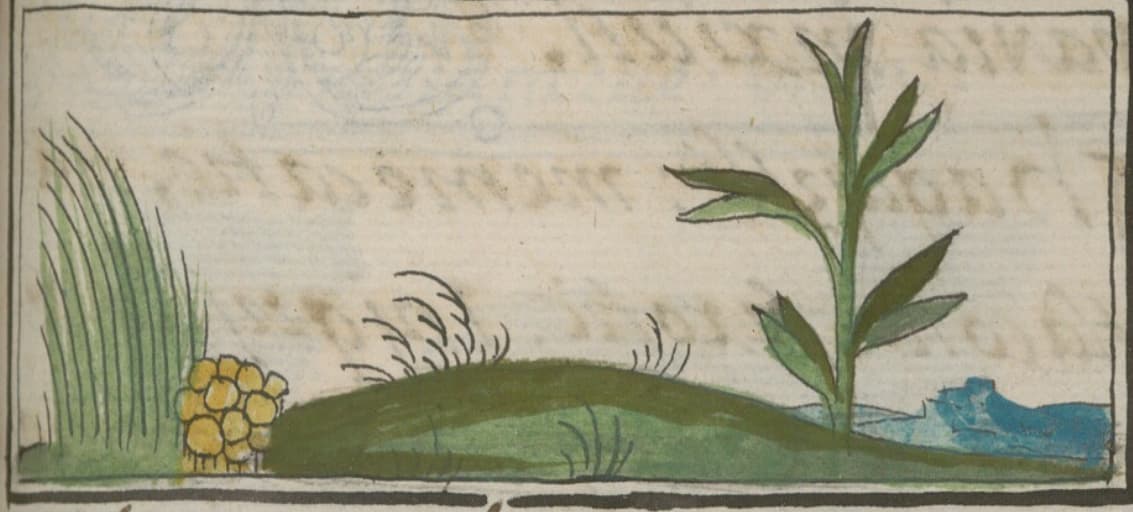
Florentine Codex images of Teonanácatl and Tochtetepon. The yellow circles on the left are the main character of this episode, Teonanácatl, and the plant on the right is called Tochtetepon, which is described as toxic and deadly when mixed with water. Source: Digital Florentine Codex
In his records, he mentioned that locals would use some psychoactive substances (intoxicate plants), including peyotl (peyote) that grew like truffles, which after consumption would cause people to see terrifying or amusing "things." There was also a type of mushroom called teonanácatl, about which he wrote:
In this land, there is a small fungi called teonanácatl, which usually grows under haystacks or on plains. In appearance it is round, with a rather long stem, slender and cylindrical. It tastes strange when eaten, causes throat discomfort, and produces an intoxicated feeling. It can be used to treat fever and rheumatic symptoms. Only two to three can be consumed at a time. Sometimes after eating them one sees terrifying hallucinations, sometimes they cause laughter, and even after consuming a certain amount they can lead to increased sexual desire. If young people act crazy or mischievous, people say they have eaten nanácatl.
in previous chapters, Sahagún recorded how the locals conducted Areyto ceremonies, and teonanácatl also appeared in these rituals:
... At the beginning of the gathering, they would eat a small, dark mushroom called nanacatl. After consumption, it would make people intoxicated or produce hallucinations, and could even arouse sexual desire. They would consume the mushrooms before sunset, along with cacao. Additionally, the mushrooms were usually used together with honey. When the mushrooms began to take effect, they would start dancing and singing. Some people affected by the mushrooms would begin to cry; others would sit and remain silent, deeply lost in contemplation; some would see their own death and weep; some would see themselves being devoured by fierce beasts; some would see visions of themselves being captured in war...
From his descriptions and images, it can be determined that teonanácatl should be some type of fungi, which locals would consume during ceremonies, and after consumption would produce hallucinations, or be used as medicine to alleviate fever and other symptoms.
But even with Sahagún's records, the true identity of this small, dark mushroom wasn't revealed by researchers until over a hundred years later.
Mushrooms? Cactus?
Fast-forwarding from the sixteenth century to 1915, when Safford in an article1 , regarding the mystery that had persisted for hundreds of years about what teonanácatl actually was, he offered his perspective.
He believed that although people who had previously described teonanácatl called it a mushroom, those people were not observing teonanácatl in its fresh state, but rather its dried appearance; additionally, in past records, teonanácatl was found in northern Mexico and southwestern United States, but among the known mushrooms in these regions, none matched the description of teonanácatl.
Combining the above factors, along with other people's descriptions of peyote, he believed that teonanácatl was not fungi at all, but rather the cactus peyote that was distributed in the aforementioned regions and similarly possessed psychoactive properties.
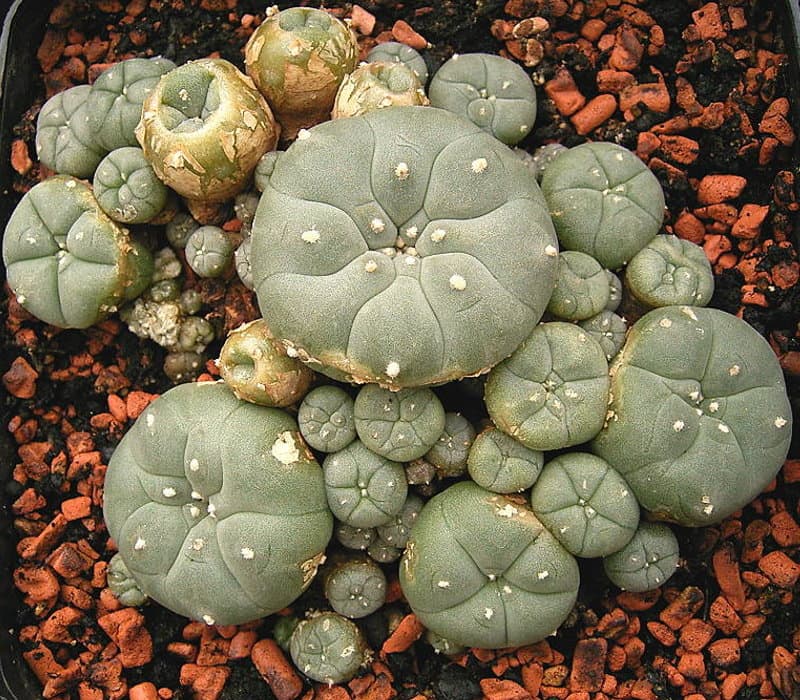
Peyote plant photo. Source: Wikimedia
The scientific name of peyote is Lophophora williamsii, a plant species in the genus Lophophora J.M.Coult. under the family Cactaceae, which is the peyotl mentioned in Sahagún's records.
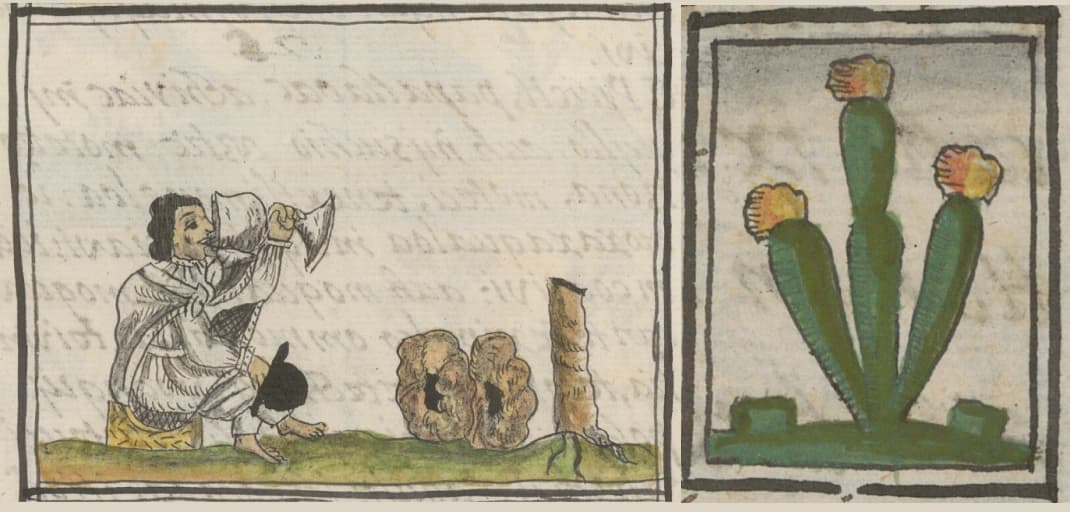
Image of peyotl recorded in the Florentine Codex. Source: Digital Florentine Codex
Safford believed that the entire appearance of peyote looks like a carrot (right image below), which is completely different from the commonly perceived appearance of mushrooms. However, after peyote is longitudinally cut and dried, its appearance becomes like some kind of mushroom, making it difficult even for trained mycologists to distinguish.
So he believed that peyotl and nanacatl recorded by Sahagún both refer to the peyote plant, with the difference being that peyotl was used as the name for this plant, while nanacatl referred to its form after being cut into sections and dried.
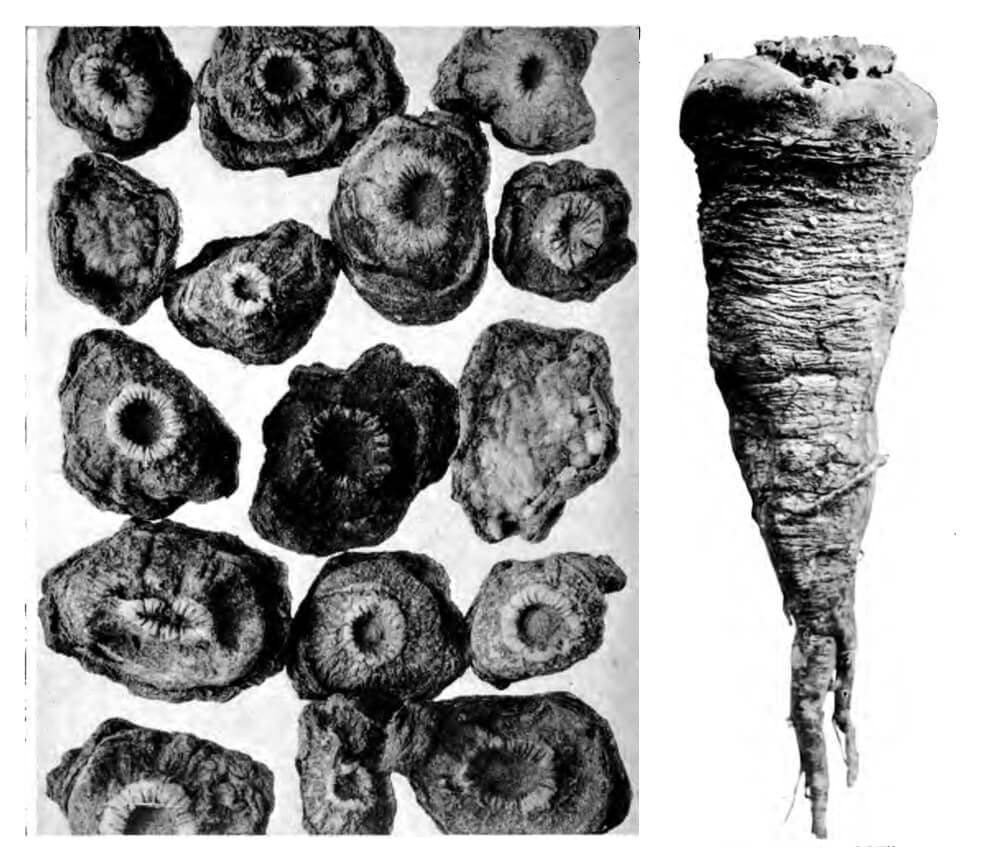
Teonanacatl and Peyote. Left: Teonanacatl; Right: Peyote plant
Safford's argument attracted widespread attention and was generally accepted by academia. However, Blas Pablo Reko, who had extensive experience with botanical collection and anthropological research in Mexico, disagreed with his view. Reko believed that Sahagún's teonanácatl should refer to some kind of mushroom, not peyote. In a letter, he mentioned that Safford was wrong to say that teonanacatl was peyote, because according to Sahagún's records, teonanácatl would grow on dung heaps and was a type of fungi.
... I see in your description of Lophophora that Dr. Safford believes this plant to be the 'teonanacatl' of Sahagun which is surely wrong. It is actually, as Sahagun states, a fungus which grows on dung-heaps and which is still used under the same old name by the Indians of the Sierra Jaurez in Oaxaca in their religious feasts.
In 1940, Harvard University ethnobotanist Richard Evans Schultes examined Sahagún's records and, combining experts' opinions, proposed a different view on the true identity of teonanácatl2.
Schultes reviewed Sahagún's records and found that when Sahagún mentioned teonanácatl, he always called it a mushroom (champignon), while when mentioning peyotl, he called it an "earth-cactus" that grows on the ground, clearly indicating the difference between the two.
In Sahagún's records, there are also descriptions of other mushrooms. For instance, chimalnanácatl refers to large, round mushrooms that can be eaten after cooking. Additionally, there are tree-growing mushrooms called cuauhnanacatl, which taste good both roasted and boiled. These mushroom names all share a common feature: they all have the suffix nanacatl.
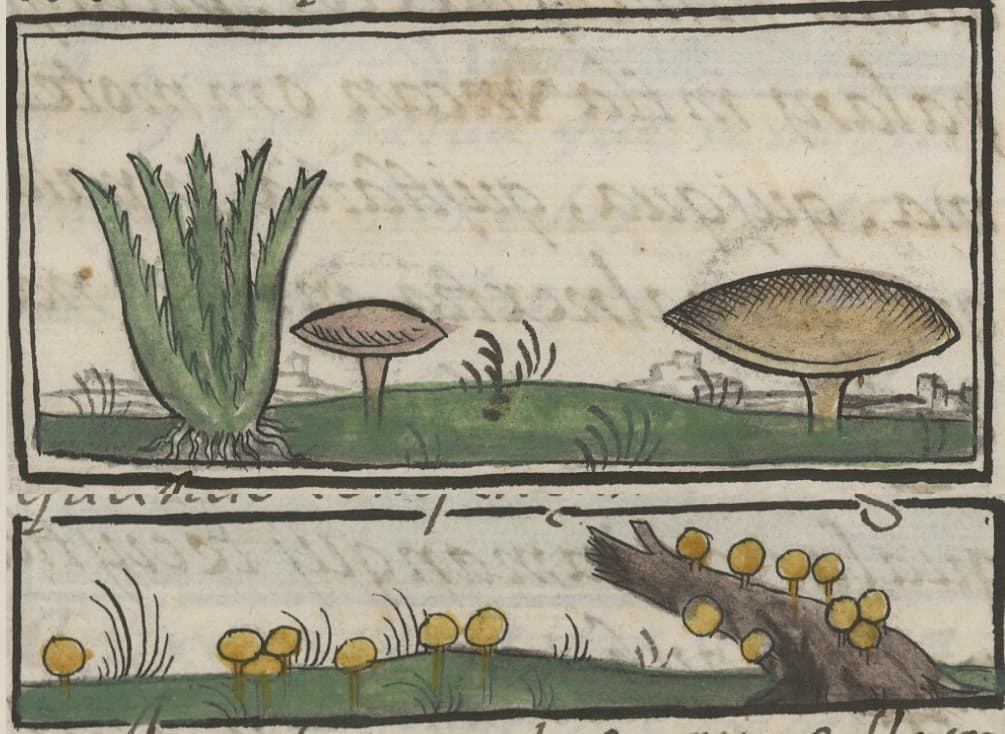
Disc-shaped chimalnanacatl and tree-growing cuauhnanacatl. Source: Digital Florentine Codex
Besides Sahagún's records, Schultes also mentioned nanacatl that appeared in other literature. For example, the Nahuatl language compiled by Rémi Siméon3 dictionary4 wrote that Nanacatl refers to mushrooms:
NANACATL, s. Champignon; quauhtla nanacatl, champignon des bois; au fig. nanacatl nicte-ittitinemi (Olm.), rendre quelqu'un pervers, lui donner de mauvais conseils. En comp. : nonanac ou nonanacauh (Olm.), mon champignon. R. nacatl (?).
The dictionary also mentions teonanácatl, describing it as a small mushroom that tastes bad and causes hallucinations:
TEONANACATL, s. Espèce de petit champignon qui a mauvais goût, enivre et cause des hallucinations; il est médicinal contre les fièvres et la goutte (Sah.). RR. teotl, nanacatl.
Many other documents also use nanacatl or similar roots when describing mushrooms; and in modern times, nanacates is still used in Mexico to refer to edible mushrooms. All evidence indicates that Sahagún wasn't messing around, teonanácatl should refer to mushrooms rather than the peyote cactus, and specifically the magic kind 🍄.
Etymology Teonanácatl
We can view teonanácatl as a combination of teo + nanacatl. Based on the discussions above, we can confidently say that the latter part nanacatl means mushroom, but what does the prefix teo refer to?
While researching, I found a very interesting website Visual Lexicon of Aztec Hieroglyphs. It is an online database that contains many Nahuatl hieroglyphs and their meanings. The data primarily comes from two works: The Codex Mendoza and The Matrícula de Huexotzinco.
The Aztecs communicated through a "writing" system that depicted the appearance of objects (pictographs) or combined images with two meanings to create another meaning (ideographs). The Codex Mendoza recorded the history, tributary relationships, and social activities of the Aztec Empire through this writing system; another manuscript, Matrícula de Huexotzinco, was a census report conducted by the Spanish in the Huexotzinco region at that time.
In the Visual Lexicon of Aztec Hieroglyphs database, searching for "teo" you will find many images, and in these images there is a semicircular disc pattern element, which is the teo we are looking for, also called teotl.
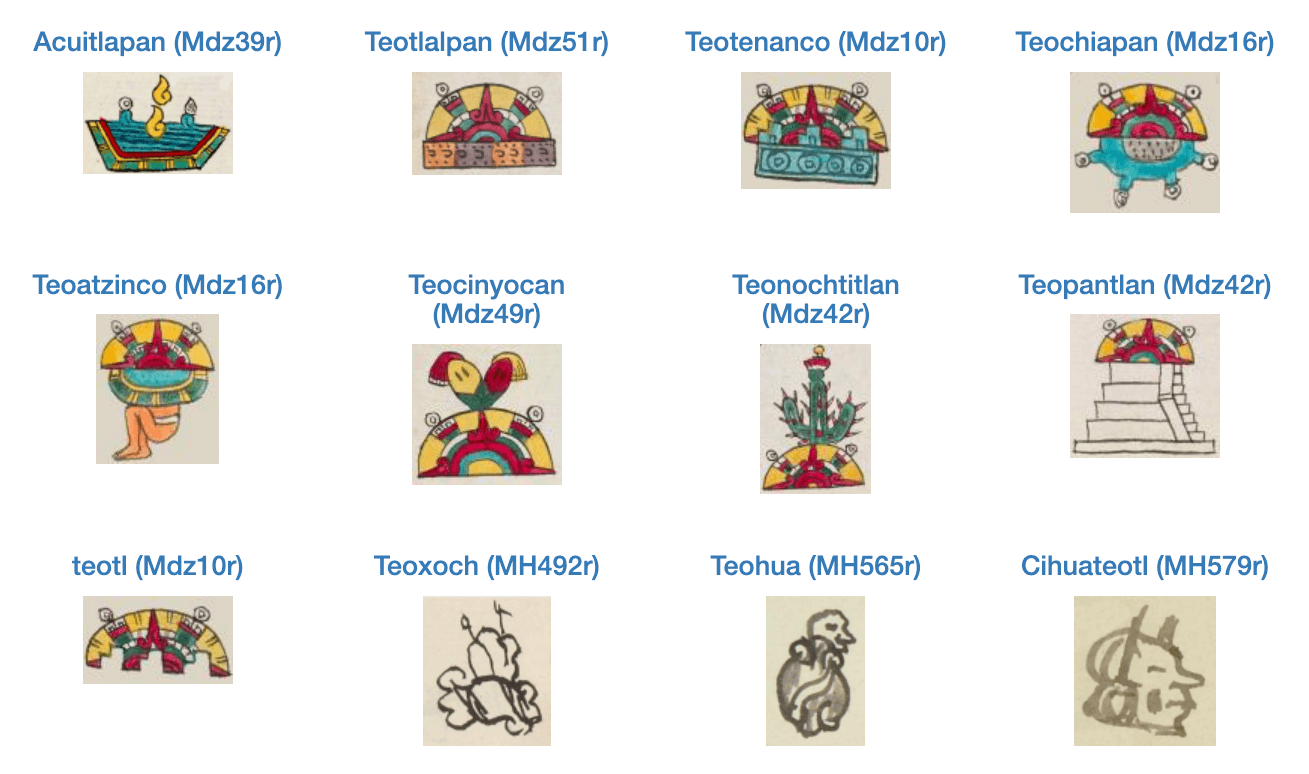
Search results for "teo" in the Visual Lexicon of Aztec Hieroglyphs, the teotl we're looking for is in the bottom left corner. Source: Visual Lexicon of Aztec Hieroglyphs
Teotl is a semicircular disk-shaped image composed of yellow, green, white, and red colors, with sacred, divine power, solar, and calendrical meanings. In pronunciation, teotl is usually used as a prefix (teo-) combined with other words, such as sacred mushroom teonanacatl (teo + nanacatl) or temple Teopantlan (teo + pan + tlan).
Additionally, gold in Nahuatl is called teocuitlatl (teo + cuitlatl), meaning "God's excrement 💩". If you want to understand 🧈 the fascinating changes in the names for gold across various Mesoamerican civilizations (some civilizations called gold or coins God's excrement, while others called it the sun's excrement), you can refer to this article
If you complete the circular part on the other half of teotl, it becomes another hieroglyph tonatiuh, which means sun.
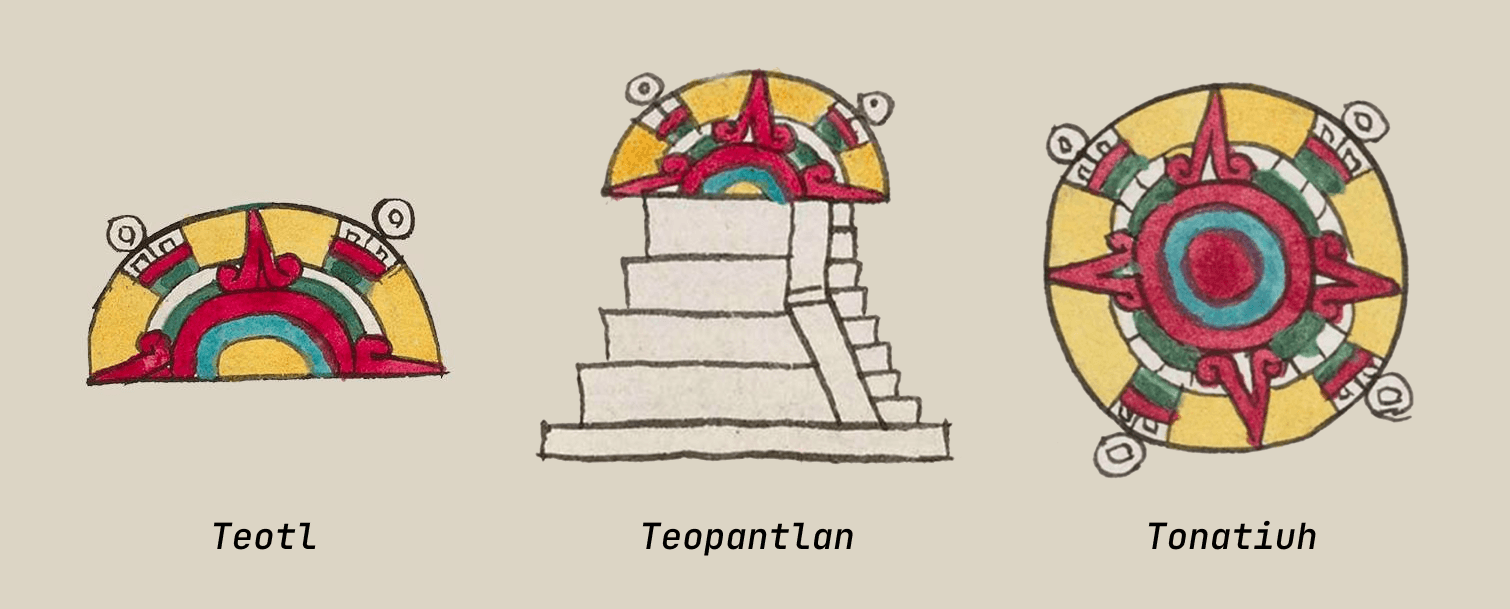
Teotl (sacred), Teopantlan (temple), and Tonatiuh (sun) hieroglyphs. Source: Visual Lexicon of Aztec Hieroglyphs
Now we know that the teo at the beginning of teonanácatl represents the sacred, divine power; while nanácatl means mushroom, so when combined, teonanácatl can be understood as "sacred mushroom."
But actually in Safford's article, besides Sacred Mushroom, he also used another name to refer to teonanácatl, which is God's Flesh. Hubert Howe Bancroft also in his work5 with flesh of god as an alternative name:
...Among the ingredients used to make their drinks more intoxicating the most powerful was the teonanacatl, 'flesh of god,' a kind of mushroom which excited the passions and caused the partaker to see snakes and divers other visions.
Those who support this theory believe that nanácatl is the plural form of nácatl, and nácatl in Rémi Siméon's dictionary refers to "flesh" or "meat."
NACATL, s. Chair, viande; nacatl amoyollo, votre cœur charnel; amo omiyo nacatl, chair, viande sans os. En comp. : nonac, ma viande, la chair que je mange. Voy. Nacayor.
Spanish missionary Toribio de Benavente Motolinia also referred to teonanácatl as carne de dios (flesh of god):
...But the mushrooms that grow in this land are even more peculiar. Since eating mushrooms raw has a bitter taste, they usually drink some honey after eating them, or consume them together with honey. And within a short time after consumption, they begin to experience all kinds of strange hallucinations, especially of snakes. When they become detached from all sensory perception, they feel their legs and bodies crawling with insects that are alive and gnawing at their flesh. In this semi-mad state, they run out of their houses, longing for someone to kill them. In this intoxicated state, accompanied by pain, sometimes they even hang themselves, or treat others even more cruelly. These mushrooms, in their language called teonanácatl, meaning "God's Flesh" — or the flesh of the demons they worship. Through this means, their cruel deity administers communion to them with this bitter food.
But Robert Gordon Wasson believed that interpreting teonanácatl as Flesh of God was a misinterpretation. In his work6 mentions that the Teo- in teonanácatl means divine or wondrous or awesome, and teonanácatl is a divine, wondrous, or awesome mushroom. Moreover, Teo cannot be used as a possessive form of "god," meaning it cannot be called "god's" something.
He believes this misunderstanding arose because the missionary Motolinia came to Central America with a Christian theological perspective and attempted to understand and interpret Aztec beliefs through this lens. Thus, he mistakenly thought teonanácatl was equivalent to the wine and flesh in Christian communion, calling it god's flesh (carne de dios). However, the "god" here refers to various deities in the Aztec polytheistic belief system, such as the commonly heard Quetzalcóatl the Feathered Serpent, Xochipilli the Flower Prince, and Mictlanteuctli the god of death and the underworld. In the eyes of Spanish missionaries at the time, these foreign gods were demonic beings.
In summary, we can see that the use of magic mushrooms can be traced back to Aztec civilization, and the two names currently used to refer to psychoactive fungi - Sacred Mushroom and God's Flesh - both originate from the Nahuatl word Teonanácatl, which refers to a fungus rather than the peyote cactus, and the name God's Flesh may have been a misinterpretation within the religious context of that time.
I understand the theory, but how magic are magic mushrooms?
Now that we understand that teonanácatl really are mushrooms, let's look at the magical aspects inside the mushrooms.
Magic mushrooms is actually a general term rather than referring to a specific species. Roughly speaking, magic mushrooms refer to those large fungi that contain psychoactive substances. But among them, the most widely known are probably the species of the genus Psilocybe (Fr.) P. Kumm.
In 1958, Albert Hofmann7 Purified from hallucinogenic mushrooms, the main psychoactive substance psilocybin derives its name from the genus name Psilocybe, commonly translated in Chinese as 裸蓋菇鹼, 裸蓋菇素, or directly transliterated as xiluoxibin/sailuoxibin.
Some hallucinogenic mushrooms' psychoactive effects mainly come from psilocin, which is formed when Psilocybin is dephosphorylated by phosphatases in the body, removing the phosphate group, and can bind to numerous serotonin receptors. Among these, psilocin and 5-HT2A receptors, which is the primary source of psychoactive effects in these hallucinogenic mushrooms. Past human experiments have shown8, subjects receiving 5-HT2A receptor blocker ketanserin significantly reduced the efficacy of psilocybin, indicating 5-HT2A receptors play a crucial role in the psychoactive effects of hallucinogenic mushrooms.
Besides the genus Psilocybe, past research has indicated that some species within genera such as Panaeolus (Fr.) Quél., Pluteus, Gymnopilus, Amanita Pers., Inocybe (Fr.) Fr., and Pholiotina Fayod also contain psychoactive substances. The chemical composition and mechanisms of action on the human body may vary considerably among different genera or species of hallucinogenic mushrooms.
Most hallucinogenic mushrooms containing psilocybin develop blue "bruising" marks when their tissue is injured or damaged. Research shows9 that this phenomenon originates from psilocybin being dephosphorylated by PsiP phosphatase to remove the 4-O-phosphate group, producing psilocin which is subsequently oxidized by laccase PsiL and loses the 4-hydroxyl group, and finally these reaction residues oligomerize together, with the quinone structural units being the source of the "bruising".
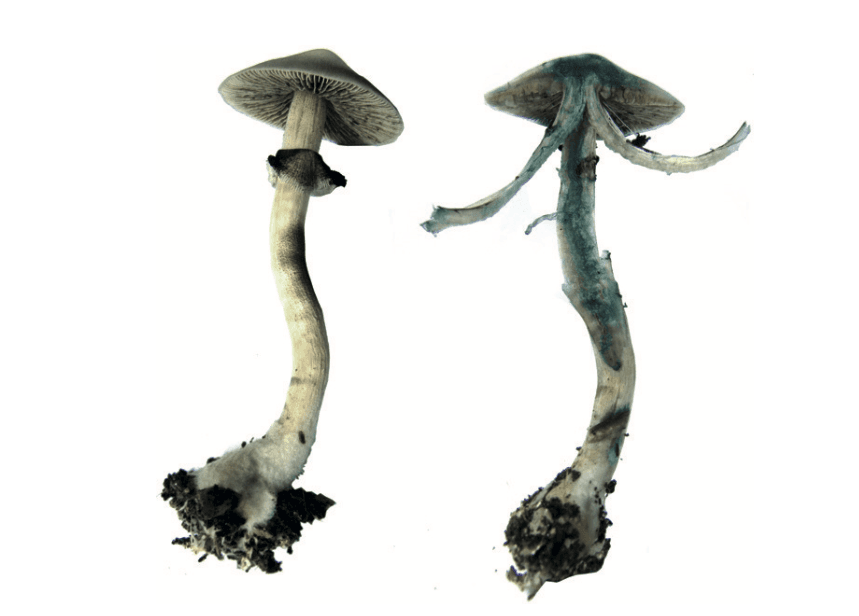
Psilocybe cubensis blue bruising reaction. Left image shows uninjured Psilocybe cubensis, right image shows Psilocybe cubensis after injury. Source: Lenz C. et al. (2020)
Certain species produce toxic metabolites in addition to psilocybin. For example, some species in the genera Inocybe and Amanita contain muscarine, which after consumption leads to significant salivation, tearing and sweating, vomiting, diarrhea and stomach pain, and may even pose a fatal risk when consumed together with alcohol or other drugs.
Now that we have some understanding of these fungi containing psychoactive substances, which 🍄 does the teonanácatl described by Sahagún refer to?
The Mystery of Teonanácatl's Origins
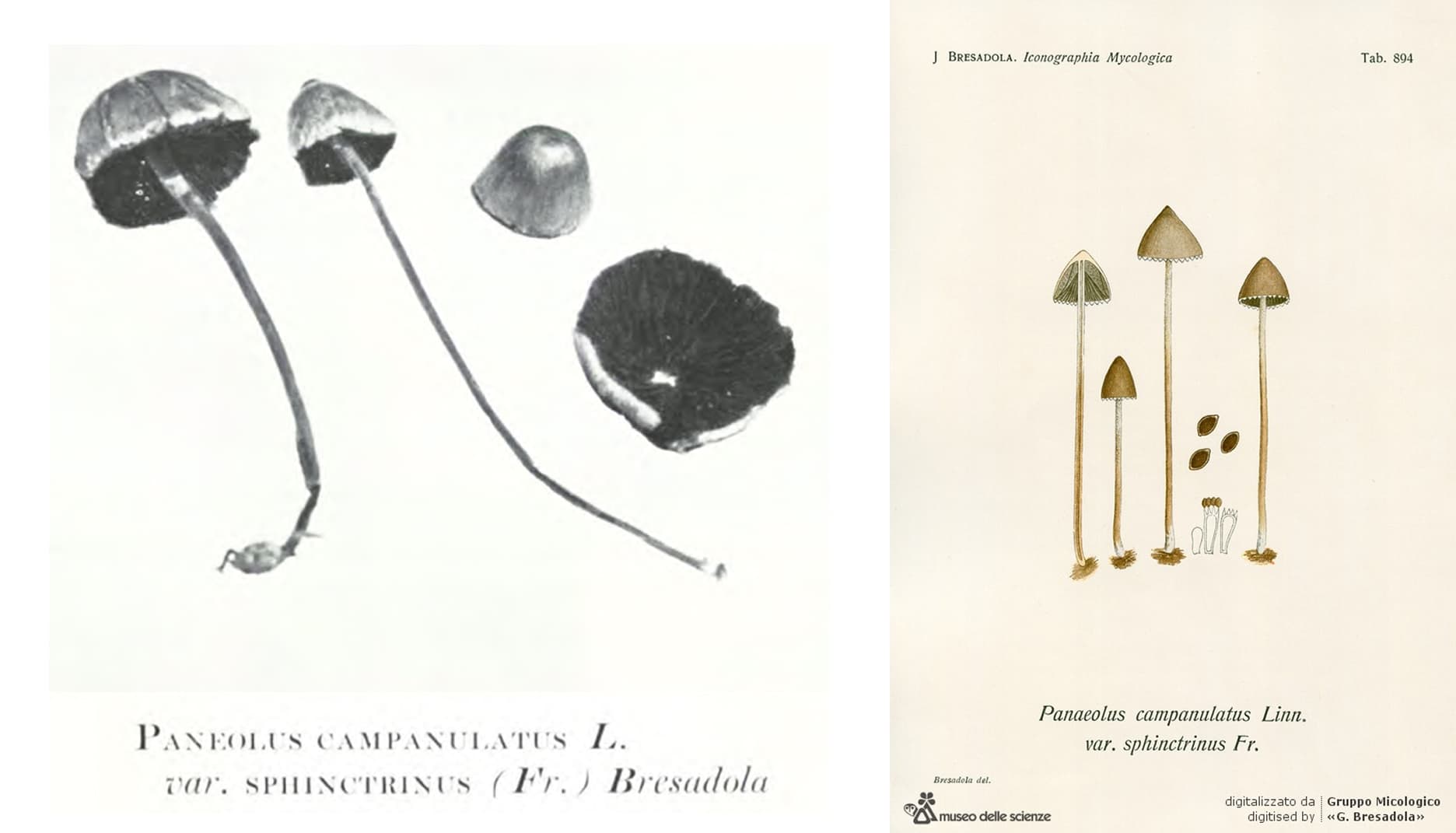
Panaeolus campanulatus var. sphinctrinus。Source: Schultes 1939, Giacomo Bresadola Iconographia Mycologica
In 1936, Roberto J. Weitlaner, who was both an ethnologist and an engineer, traveled to the small town of Huautla de Jimenez to conduct linguistic research and collected some specimens that might be Teonanácatl. These specimens were eventually sent to Harvard University for identification, but unfortunately they had already decomposed and were difficult to identify before arrival.
In 1937, Reko gave specimens collected from the Puebla region to Schultes. Although they could not be identified to the species level due to poor preservation, Schultes believed they belonged to species of the genus Panaeolus and had a close relationship with specimens collected from Oaxaca.
A year later, Schultes traveled to Oaxaca to conduct research, attempting to unveil the mystery of Teonanácatl. He brought back three specimens and sent them to Harvard's Farlow Herbarium, two of which were purchased from local Mazatec people, and the third was collected by Schultes himself. This specimen was subsequently identified by Harvard University's David Linder as a species of the genus Panaeolus - Panaeolus campanulatus L. var. sphinctrinus. Schultes then believed this was the teonanácatl used by the Aztec people hundreds of years ago.
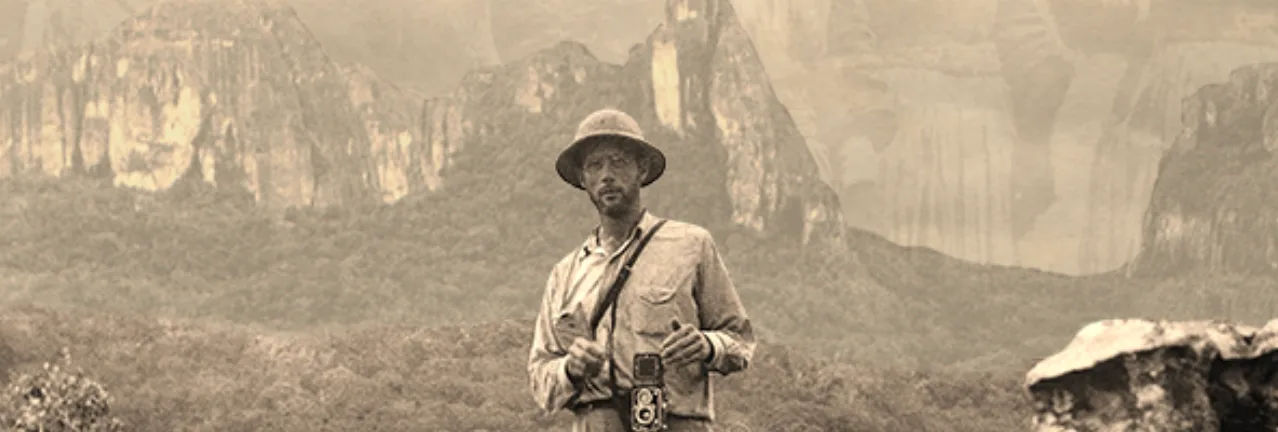
Richard Evans Schultes. Source: The Amazonian Travels of Richard Evans Schultes.
Schultes is one of the most renowned scholars of the twentieth century, making significant contributions to taxonomy and ethnobotany. Starting in 1941, he began his field investigations in Central and South America, venturing into the Amazon rainforest and surrounding countries to explore the plant use, rituals, and cultural backgrounds of various indigenous groups. Schultes collected over 24,000 plant specimens, 300 of which were even new scientific discoveries. For detailed traces of Schultes' journeys, you can refer to The Amazonian Travels of Richard Evans Schultes。
Schultes' research had already identified the possible species of teonanácatl, but to truly understand the role of these sacred mushrooms in local culture, more direct field evidence might still be needed for verification. Over a decade later, another group of scholars continued this magical journey.
To solve the mystery of teonanácatl's origins and personally participate in the enigmatic ceremonies, R. Gordon Wasson and his wife Valentina Pavlovna10 a group of people who visited Mexico multiple times between 1953 and 1958. With the information and help of local guides, they personally participated in the , and documented the entire process in detail through text and images with his colleague and photographer Allan Richardson, bringing back several specimens of the mushrooms used in the ceremonies as voucher specimens.
Subsequently, Wasson handed over the samples collected during these trips to the accompanying French mycologist Roger Heim for identification and cultivation. These samples brought back from Mexico covered species from three genera: Psilocybe, Stropharia, and Conocybe, with the most diverse being species from the Psilocybe genus, such as
- Psilocybe mexicana Heirn.
- Stropharia cubensis Earle. (treated as Psilocybe cubensis according to new classification)
- Psilocybe cxrulescens Murr. var. maxatecorum Heirn
- Psilocybe aztecorum Heim
Among these were many new species, such as Psilocybe mexicana and Psilocybe aztecorum. Roger Heim published his research results in 1956, confirming for the first time that multiple species in the genus Psilocybe were the sacred mushrooms used by local Mexican tribes for ceremonies.
Additionally, in 1940, Rolf Singer re-examined the specimens brought back by Schultes. Among these, besides species from the genus Panaeolus, one of the other two specimens was identified as a species from the genus Psilocybe. The last specimen was initially identified by Singer as Deconica sp., and later Guzmán11 Reidentified that specimen, believing it should be Psilocybe caerulescens, one of the important sacred mushrooms of the Mazatecs.
Remember the Swiss chemist Albert Hofmann mentioned above who successfully purified the psychoactive substance psilocybin from magic mushrooms? The fresh material he used was provided by Roger Heim.
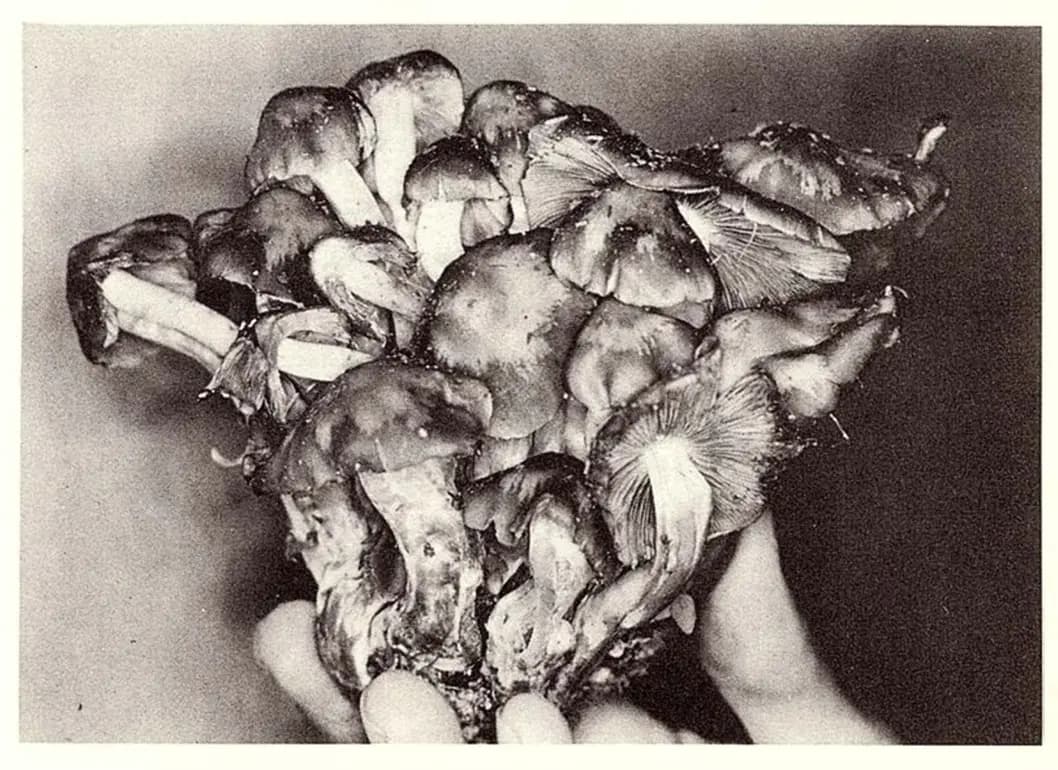
Wasson's party used Psilocybe caerulescens Murrill var. mazatecorum Heim mushrooms in the velada ceremony. Source: The wondrous mushroom: mycolatry in Mesoamerica
Building upon the research and field investigations of Schultes, Wasson, Heim, and Guzmán, we finally solved this centuries-old mystery — the small, dark magic mushrooms teonanácatl are actually species from the genus Psilocybe.
According to Guzmán's research12, many indigenous tribes throughout Mexico have traditions of using psilocybe for ceremonies. Due to altitude and other climatic factors, species of the genus Psilocybe have different distributions in different regions, so tribes in different areas use different types of psilocybe.
Like the Nahuatls living west of the volcano Popocatépetl 🌋 (Nahuatl popoca smoking + tepetl hill) who use Psilocybe aztecorum growing in high mountain grasslands interwoven with pine trees, called apipitzin in Nahuatl (translated as niño de las aguas in Spanish), meaning "children of the rain." While the Matlazincs indigenous people living in the Nevado de Toluca region use Psilocybe muliercula and P. sanctorum, which they call santitos (little saints).
The Nahuatls living in Necaxa, Puebla use Psilocybe caerulescens and P. mexicana, which they call teotlaquilnanácatl (Nahuatl teo sacred + tlacuilo painter/writer + nanacatl mushroom) translated as "sacred mushrooms that paint."
Guzmán believes the term teotlaquilnanácatl is very similar to the teonanácatl recorded by Sahagún, and the mushroom image depicted in the Codex Magliabechiano closely resembles P. caerulescens, so he speculates that P. caerulescens is the teonanacatl described by Sahagún back then.
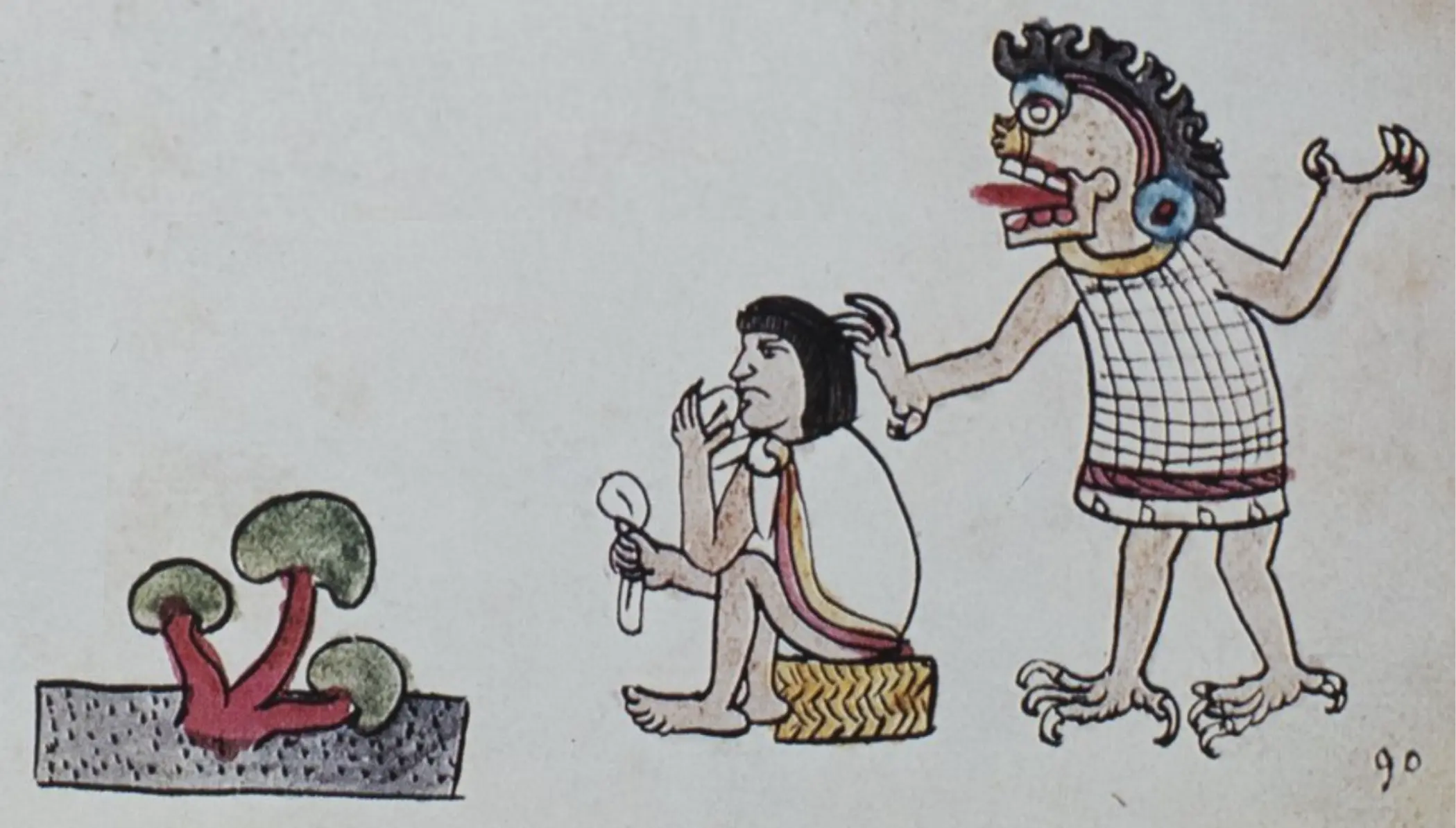
Depiction of teonanácatl and a man (priest?) consuming teonanácatl recorded in the Codex Magliabechiano, with a deity standing behind him (possibly Mictlāntēcutli, the god who rules the land of the dead) Source: Codex Magliabechiano
Scientific Discoveries Behind the Scenes: Cultural Exploitation, Piracy and Appropriation
After the journey to Mexico, in 1957, R. Gordon Wasson and his wife Valentino P. Wasson published an article "Seeking the magic mushroom" in LIFE magazine, revealing the ancient and mysterious rituals of Mexico to the world through text and images. Although Wasson used the pseudonym Eva Mendez to hide María Sabina's true identity and did not reveal the specific location of the village, it still caused Western pilgrims and hippies from all over to flock to María Sabina's hometown of Huautla de Jiménez.
These people from various places intruded and disrupted the original tranquility of the small town, openly and wantonly discussing magic mushrooms in various media, chewing mushrooms under trees or by cliffs, but locals never did this. They always conducted vigil ceremonies in careful, secretive ways, never publicly promoting them, and never mentioned the "name" of magic mushrooms, always using euphemisms like "Little things" or "Little saints."
In addition, some disorderly behavior by outsiders attracted government attention, leading the Mexican federal government to begin intervening in Huautla in 1967, expelling those suspicious outsiders. María Sabina was taken to San Andrés Hidalgo for investigation after being accused of selling mind-altering tobacco to young people. Subsequently, the Mexican government, in response to the United Nations Convention on Psychotropic Substances (1971), amended the Código Sanitario de los Estados Unidos Mexicanos, adding hallucinogenic mushrooms to the list of controlled narcotics.
The Depletion of Divine Power
María Sabina's power came from the "libro" (book), a book of language and wisdom, a book that existed only in her consciousness. She believed this power and the wisdom to interpret the language of the "saints" could not be inherited—it was an innate gift.
When the saints entered the body of a wise person (sabio) like María Sabina, the saints would begin to speak, and María Sabina served only as a medium and translator, conveying their words to others in the ceremony.
After the arrival of foreigners, the previously secret rituals and saints were exposed and discussed in the open, María Sabina said13:
Before Wasson came, I felt the Holy Child lift me to another realm; now, I can no longer feel that power, the power of the Holy Child has dissipated. If Cayetano (the local official who contacted Wasson) had not brought those outsiders, the Holy Child would still retain Their power. And from the moment the outsiders arrived, the Holy Child lost Their purity and power, the outsiders defiled Them, making Them unable to manifest divinely anymore. This is now irreversible.
Another wise person, Apolonio Terán, expressed similar views in conversation:
...Listen, what's worse is that the sacred mushrooms no longer belong to us. Their sacred language has been desecrated. Their language has been defiled and we can no longer interpret it. Now, the Holy Child has begun to speak English (nqui3le2)! Yes, that's the language those outsiders spoke. The mushrooms have sacred souls, and those souls have always belonged to us. But the arrival of foreigners frightened them away. Now, they wander aimlessly in the air with the clouds. And it's not just the Holy Child that has been desecrated, our (Mazatec) souls have also been shamed.
When Wasson recalled his decision to publicly reveal magic mushrooms to the world, he believed he was indeed the sinner María Sabina spoke of - the one who ended an ancient secret tradition that had been passed down continuously and secretly for thousands of years. Between "making it public and ending this tradition" and "burying the mushroom secret forever," he clearly chose the former. He believed that rather than letting this tradition gradually wither away until no one knew of it, it would be better to present it solemnly to the world.
Today, wild mushrooms have been cultivated into varieties with higher concentrations of psychoactive substances. The medical value of psilocybin, the active substance in mushrooms, has been proven in many studies to combat depression, addiction, and other mental disorders, with potential commercial value in the hundreds of billions of dollars. Perhaps more people are chewing magic mushrooms under trees, by cliffs, or even on the streets for spiritual experiences or pure entertainment; but at the same time, more people have undergone formal or informal treatments and opened new chapters in their lives.
Conclusion
The small, dark mysterious mushrooms described by Sahagún, from being mistaken for the cactus peyote, to scholars from various places successively traveling to Mexico to conduct field research, participate in ceremonies, and finally reveal them to the world. Although this tradition may have escaped the fate of extinction, cultural appropriation and exploitation have genuinely affected María Sabina's life, the essence of traditional culture, and even the purity of the "sacred children." Like the Jesus portrait on the altar and María Sabina's oral accounts, they all demonstrate that the culture from hundreds of years ago and the religion brought by Spanish colonization have perfectly merged and been absorbed into the indigenous worldview. Perhaps in the near future we can see another fusion of tradition and foreign culture, producing an entirely new appearance.
Reference
- Visual Lexicon of Aztec Hieroglyphs, ed. Stephanie Wood (Eugene, Ore.: Wired Humanities Projects, University of Oregon, ©2020-present). Version 1.0.
Footnotes
-
Safford, W. E. An Aztec Narcotic (lophophora Williamsti): So-called “sacred Mushroom,” or Teonanacatl, Still in Use by the Indians of Mexico and the United States, Producing Hallucinations of a Remarkable Nature, Is Identified With the Peyotl Zacatecensis, or Devil‘s Root of Ancient Mexico, and the “mescal Button” of Texas. Journal of Heredity, 6(7). back
-
Whiting, A. F. (1940). Plantae Mexicanae II, The Identification of Teonanacatl, a Narcotic Basidiomycete of the Aztecs. Richard Evans Schultes. (Botanical Museum Leaflets, Harvard University, Vol. 7, No. 3; 37-54, 1 plate, Cambridge, February 1939.). American Antiquity, 6(2), 184–184. doi:10.2307/275845 back
-
Uto-Aztecan language family back
-
Schlenther, U. (1965). Remi Siméon, Dictionnaire de la langue nahuatl ou méxicaine, Graz 1963. EAZ – Ethnographisch-Archaeologische Zeitschrift, 6(1), 95‐96. https://doi.org/10.54799/ZQXA5429 back
-
Bancroft, Hubert Howe, 1832-1918. (1874). The native races of the pacific states of North America. Volume I. Wild tribes E. http://dx.doi.org/10.14288/1.0222509 back
-
Wasson, R. G. (1980). The wondrous mushroom: Mycolatry in Mesoamerica. McGraw-Hill. back
-
Swiss chemist who, in addition to psilocybin, was also the first scientist to synthesize LSD back
-
Vollenweider FX, Vollenweider-Scherpenhuyzen MF, Bäbler A, Vogel H, Hell D. Psilocybin induces schizophrenia-like psychosis in humans via a serotonin-2 agonist action. Neuroreport. 1998 Dec 1;9(17):3897-902. doi: 10.1097/00001756-199812010-00024. PMID: 9875725. back
-
Lenz, C., Wick, J., Braga, D., García-Altares, M., Lackner, G., Hertweck, C., Gressler, M., & Hoffmeister, D. (2020). Injury-Triggered Blueing Reactions of Psilocybe "Magic" Mushrooms. Angewandte Chemie (International ed. in English), 59(4), 1450–1454. https://doi.org/10.1002/anie.201910175 back
-
Pediatrician, scientist, and fungi enthusiast. See The Cost of Omission: Dr. Valentina Wasson and Getting Our Stories Right back
-
Mexican mycologist, dedicated to the taxonomy and ethnobotany of genus Psilocybe. back
-
Guzmán, G. (2008). Hallucinogenic mushrooms in Mexico: An overview. Economic Botany, 62(3), 404-412. back
-
Álvaro Estrada (1981). María Sabina: Her life and chants. Ross-Erikson. back